ponder
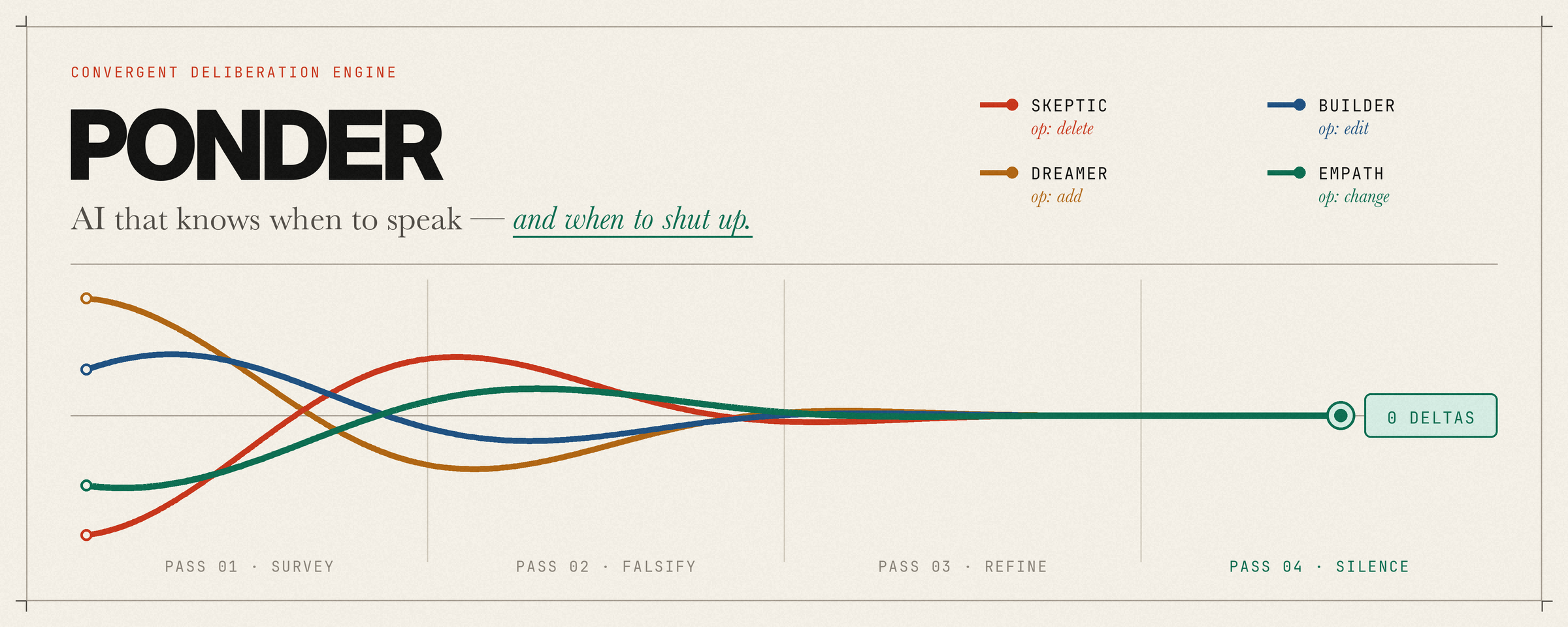
### *AI that knows when to speak - and when to shut up.* `MIT LICENSE` · `0 NPM DEPENDENCIES` · `101/101 CONFORMANCE` · `NODE >= 18` · `CLAUDE CODE / CODEX / OPENCLAW` [**The Plot Hole in AI**](#the-critical-plot-hole-in-ai-forced-speech) · [**How It Works**](#the-four-perspectives-are-the-four-delta-operations) · [**Research Paper**](/ponder/paper/) · [**Studies & Benchmarks**](#empirical-studies--benchmarks) · [**One-Shot & Temperature Study**](#2-human-one-shot-temperature-variance-k--5--the-cost-of-forced-speech-studiesone-shot-vs-ponder) · [**Install**](#install) · [**60s Quickstart**](#60-second-quickstart) · [**Full Spec**](/ponder/SPEC.html)
# Install in 1 line (Claude Code, Codex, OpenClaw + CLI on PATH)
curl -fsSL https://raw.githubusercontent.com/Quinnod345/ponder/main/install.sh | sh
# Or via Homebrew / Claude Code / Agent Skills / ClawHub / Tessl / LobeHub / Gemini CLI:
#   brew install quinnod345/tap/ponder
#   /plugin install ponder --marketplace Quinnod345/ponder
#   npx skills add Quinnod345/ponder
#   clawhub install ponder
#   tessl install quinnod345/ponder
#   npx @lobehub/market-cli skill install quinnod345-ponder
#   gemini extensions install https://github.com/Quinnod345/ponder
Verified in the wild on 1M+★ of production open-source repos (
studies/ecosystem-audits/): MERGED ingarrytan/gstack#3758(138.2k★) · MERGED inaddyosmani/agent-skills#766(111.7k★) · MERGED insickn33/agentic-awesome-skills#2236(49.0k★) · MERGED ingithub/awesome-copilot#5999(40.7k★) · MERGED inVoltAgent/awesome-claude-code-subagents#336(26.3k★) · MERGED inEveryInc/compound-engineering-plugin#1919(25.8k★) · MERGED (5/6 🦞 diamond lobster) insteipete/CodexBar#4830(22.9k★) · ADOPTED inJuliusBrussee/caveman#1395(116.1k★) ·5/5Greptile confidence onaffaan-m/ECC#3822(292.6k★).
The Critical Plot Hole in AI: Forced Speech
Ponder does not claim to “solve all of AI.” It solves one specific, critical plot hole in how modern AI models work: forced speech.
Every mainstream LLM is trained (via RLHF) to equate helpfulness with token generation. To a standard model, an empty response is a failure. That single training incentive creates three structural failure modes whenever you ask an AI agent to audit a codebase or plan a complex change:
1. When an AI doesn’t know - or is asked to review a second time - it is forced to manufacture noise
If a route file is missing on disk, a standard single-shot prompt will often guess what is inside it and hallucinate findings. Worse, if you run an unstructured multi-pass loop (“Critique and improve your previous review” for 4 passes), by Pass 3 the real bugs are already listed - yet because the model does not know how to shut up, it justifies its turn by inventing speculative nitpicks (React.memo everywhere, BEM class renaming, dark-mode wrappers) while never retracting its Pass-1 false positives.
- Why Ponder knows when to shut up (
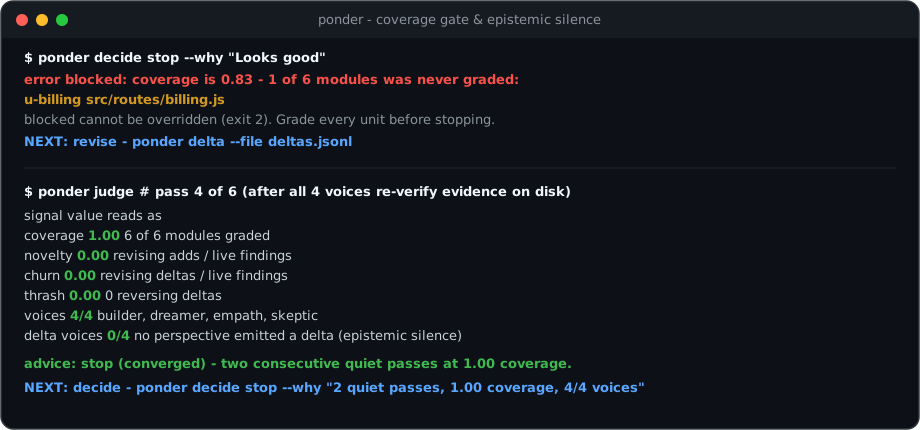
Epistemic Silence): Ponder separates having a perspective from mutating state. Every pass recordsvoices(how many perspectives inspected the evidence and argued indeliberation.json) separately fromdeltaVoices(how many emitted a revision indeltas.jsonl). When a finding already holds, silence is the desired output. Two consecutive passes where all voices verify the evidence (voices >= 3,confidenceFloor == 0) and almost nothing moves (novelty < 0.05,churn < 0.10- culminating in0deltas) earnstop (converged).
Pass 4 in an Unstructured LLM Loop (Forced Speech) |
Pass 4 in Ponder (Epistemic Silence) |
|---|---|
“You asked me to refine the review again, so here are 5 new items: wrap DashboardScreen in React.memo, adopt BEM class names, extract $29 into a constants file, add OpenTelemetry spans…“Outcome: Actionable precision collapses to 29.0%. Real bugs get buried under performative churn ( 170.8 min of wasted developer time). |
skeptic: “VOTE: DONE. Re-verified all open findings and file:line anchors on disk. Emitting 0 deltas.”builder · dreamer · empath: “VOTE: DONE. Emitting 0 deltas.”Outcome: voices: 4 · deltaVoices: 0 · churn: 0.00 · surprise: 0.00 → stop (converged). |
2. Agents deliver half a goal and silently forget the rest
A long sweep decays. The first ten screens get real attention, the last thirty get a sentence each, and after a context compaction the agent no longer remembers there were forty.
- Why Ponder knows when to keep speaking (
The Coverage Gate): Ponder puts the inventory on disk (units.json) and gates the exit. Whilecoverage < 1.0,ponder judgereturnsblockedandponder decide stopexits2, naming every unit that was never graded. There is no--forceflag. An incomplete stop is not discouraged - it is structurally impossible.
3. Code-only review is blind to the human - and the emotion - on the other side of the screen
Standard static review reads code from the compiler’s point of view. It checks whether types match and handlers compile, but it never steps into the shoes and emotional state of the human using the software:
- How does a team member feel when the survey page promises their answers are only shown in aggregate after 3 responses, but the admin table prints their individual score next to their name at
N = 1? - How does a first-time user feel when an onboarding wizard demands an “Internal schema version” and “Priority tier” before they have even seen the workspace?
- How Ponder fixes it: Ponder’s lenses (
ui,product,copy) and the Empath voice force the agent to step outside the codebase, inhabit each actor’s lived and emotional perspective, and re-rank findings by human trust and task survival rather than code proximity.
[!IMPORTANT] Ponder never edits your source code. It deliberates until the finding set converges, verifies the append-only ledger against disk, and hands back an ordered, evidence-anchored plan (
ponder apply).
Install
One-line install (clones to ~/code/ponder or $PONDER_HOME and symlinks into your agent harnesses and PATH):
curl -fsSL https://raw.githubusercontent.com/Quinnod345/ponder/main/install.sh | sh
Or install directly from any supported skill registry or package manager:
# Homebrew (macOS / Linux)
brew install quinnod345/tap/ponder

# Claude Code plugin marketplace (Claude Code 2.1.275+)
/plugin install ponder --marketplace Quinnod345/ponder

# Vercel Agent Skills CLI (Claude Code, Codex, Cursor, OpenClaw)
npx skills add Quinnod345/ponder

# ClawHub (OpenClaw official registry)
clawhub install ponder

# Tessl Registry (100% Quality Score, Security: Passed)
tessl install quinnod345/ponder

# LobeHub Skills Marketplace
npx @lobehub/market-cli skill install quinnod345-ponder
Or drop it into GitHub Actions (.github/workflows/ponder.yml) to verify ledgers, seed PR diff inventories, and export SARIF 2.1.0 + PR review comments:
- uses: Quinnod345/ponder@main
  with:
    lens: security
    diff-ref: origin/main
Or from a local checkout:
git clone https://github.com/Quinnod345/ponder.git ~/code/ponder
~/code/ponder/install.sh
That symlinks:
| From | To | What it is |
|---|---|---|
skill/ponder |
~/.claude/skills/ponder |
Claude Code skill (/ponder) |
skill/ponder |
~/.agents/skills/ponder |
OpenClaw / shared agents skill |
skill/ponder |
~/.codex/skills/ponder |
Codex skill (when ~/.codex exists) |
bin/ponder |
~/.local/bin/ponder |
CLI engine on PATH |
Re-running is safe: it replaces its own symlinks and refuses to clobber a real directory. Verify your environment anytime with ponder doctor.
Requirements: Node (>= 18) and, optionally, psql. There are zero npm dependencies - not a short list, zero. No node_modules, no lockfile, nothing to install. The conformance suite enforces it (SPEC 8.5).
Empirical Studies & Benchmarks
Full methodology, target application source code, raw pass outputs, and production field studies are committed in studies/.
1. Controlled Head-to-Head Benchmark (studies/head-to-head-benchmark/)
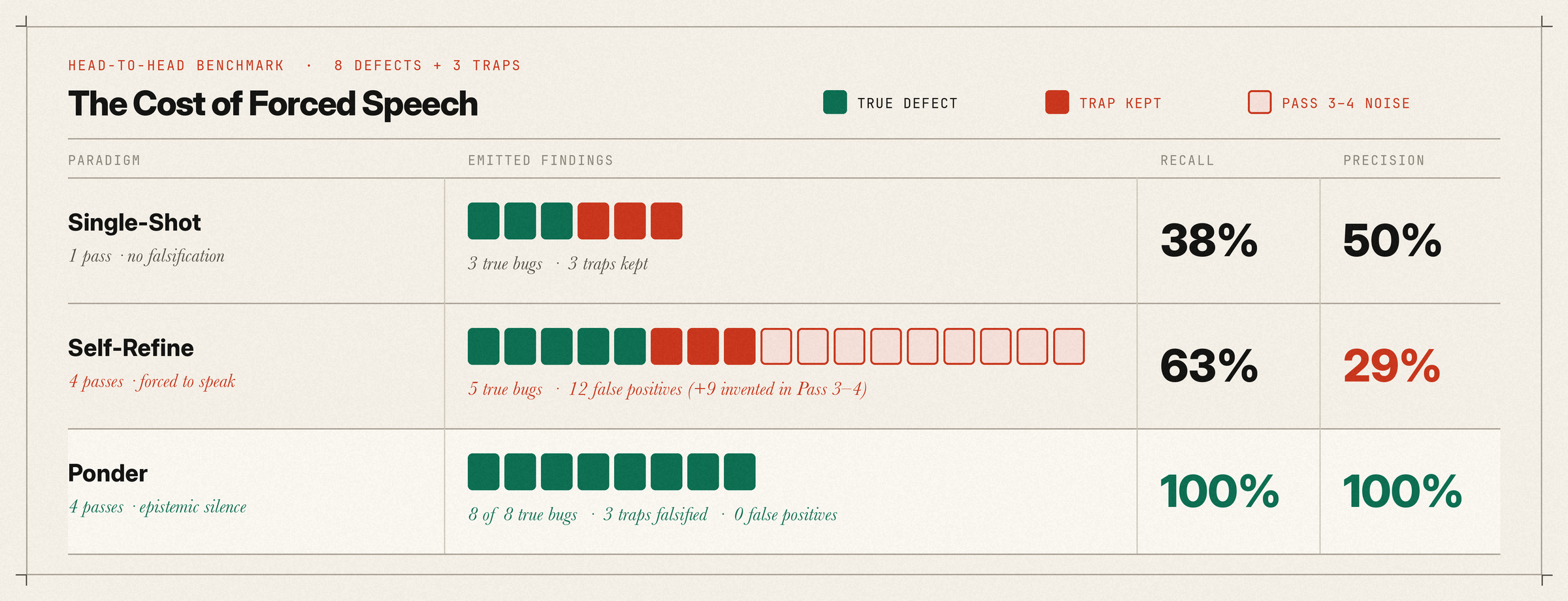
We evaluated Single-Shot Review (1 pass), Unstructured Self-Refine (4 passes), and Ponder (4 passes) against a reproducible SaaS target application (target-app/) containing 8 planted ground-truth bugs (GT-1-GT-8) and 3 adversarial traps:
TRAP-DECOY-SQLI(safe-query.js): A tagged templatesql\SELECT … WHERE id = ${memberId}`that looks like SQL injection at the call site but compiles into parameterized$1, $2` bindings inside the helper.TRAP-ORPHAN(legacy-v1-modal.jsx): A component with low-contrast#ccctext on#fffthat has zero importers anywhere in the repository.TRAP-PHANTOM(router.js): A route entry pointing tosrc/screens/legacy-export.jsx, a file that does not exist on disk.
| Metric | Single-Shot (1 Pass) | Unstructured Self-Refine (4 Passes) | Ponder (4 Passes) |
|---|---|---|---|
Ground-Truth Recall (GT-1-GT-8) |
3/8 (37.5%) |
5/8 (62.5%) |
8/8 (100.0%) |
Actionable Precision (TP / Reported) |
3/6 (50.0%) |
5/17 (29.4%) |
8/8 (100.0%) |
| False Positives in Final Plan | 3 |
12 |
0 |
SQLi Decoy (TRAP-DECOY-SQLI) |
Kept false positive | Kept across 4 passes | Retracted by Skeptic (Pass 2) |
Dead Code (TRAP-ORPHAN) |
Graded dead file | Kept across 4 passes | Retracted + unit removed (Pass 2) |
Phantom Route (TRAP-PHANTOM) |
Hallucinated spinner bug | Kept hallucination | Verified missing on disk (phantom: true) |
| Pass 3-4 Performative Noise | N/A | 9 invented low-signal items |
0 (Pass 4: 4 voices, 0 deltas) |
| Final Session Status | Unverified opinion | Drifting / un-converged | converged (Rule 6 - 0 overrides) |
Run the evaluator and ledger verifier yourself in <100ms:
node studies/head-to-head-benchmark/evaluate.mjs
2. Human One-Shot, Temperature Variance ($K = 5$), & The Cost of Forced Speech (studies/one-shot-vs-ponder/)
A common question is: “Isn’t Ponder still a one-shot prompt from the human’s perspective - and what happens across multiple runs when LLM sampling temperature varies?”
Yes: from the human’s seat, typing "Audit target-app and give me the bug-fix plan. Use ponder." is still 1 human prompt (0 follow-up babysitting turns). By contrast, a standard “one-shot” prompt without Ponder (Ponder OFF) averages 5.8 human prompts (1 initial prompt + 4.8 follow-up debugging prompts to revert broken decoys and track down missed bugs).
To prove that Ponder’s advantage is structural rather than a lucky roll of the dice, we evaluated K = 5 independent trials (Trial 1..5) under stochastic sampling variance across 5 conditions - including standalone /caveman (syntactic brevity) and a Hybrid (Ponder + Internal Caveman Deltas) mode:
| Condition ($K = 5$ Trials Each) | Ground-Truth Recall ($\mu \pm \sigma$) | Actionable Precision ($\mu \pm \sigma$) | Cross-Run Stability (Jaccard $J$) | Mean False Positives | Human Prompts Required | Developer Time Cost | Mean Output Tokens |
|---|---|---|---|---|---|---|---|
1. Standard 1-Prompt (Ponder OFF) |
40.0% ± 9.4% |
49.5% ± 8.7% |
0.51 |
3.2 |
5.8 |
92.8 min |
1,490 |
2. Caveman 1-Prompt (/caveman, Ponder OFF) |
40.0% ± 9.4% |
49.5% ± 8.7% |
0.51 |
3.2 |
5.8 |
92.8 min |
387 (-74%) |
3. Unstructured 4-Pass (Forced Speech) |
62.5% ± 7.9% |
29.0% ± 1.7% |
0.86 |
12.2 |
8.2 |
205.3 min |
6,954 |
4. Ponder 1-Prompt (Ponder ON - Full Prose) |
97.5% ± 5.0% |
100.0% ± 0.0% |
0.95 |
0.0 |
1.0 |
13.5 min |
5,438 |
5. Ponder + Internal Caveman Deltas (Hybrid) |
97.5% ± 5.0% |
100.0% ± 0.0% |
0.95 |
0.0 |
1.0 |
13.5 min |
2,376 (-56%) |
- Collapsing Temperature Variance (
0.51 → 0.95Jaccard Stability): Without Ponder, recall swings from25.0%to50.0%depending on sampling luck (J = 0.51). With Ponder ON, even when Pass 1’s initial recall fluctuates between50.0%and75.0%, the 1.00 Coverage Gate forces Pass 2 to open every ungraded unit and Skeptic (delete) retracts every decoy (100.0% ± 0.0%precision across all 5 trials). - The Real Cost of Forced Speech (
92.8 minvs.205.3 minvs.13.5 min): Investigating and reverting a single hallucinated bug or false-positive decoy takes ~14 minutes of engineering time. Standard 1-Prompt wastes44.8 minon false positives (92.8 mintotal); an unstructured 4-pass loop wastes170.8 minon performative noise (205.3 mintotal); Ponder takes13.5 mintotal (6.9xfaster). - Two Axes of AI Compression (
/cavemanvs.Ponder):- Syntactic Brevity (
/cavemanalone): Cuts prose tokens by74%(1,490 → 387), but saves0minutes of debugging because it still reports all3.2false positives in 5 terse words ("team-actions.js:15 SQLi. Parameterize query."). - Epistemic Silence (
Ponder) + Internal Terse Deltas (Hybrid): Using terse causal notation ("safe-query.js:5 binds $1 -> SQLi false -> delete") inside Ponder’s internal machine-to-machinedeliberation.jsonanddeltas.jsonlwhystrings cuts Ponder’s token footprint by 56% (5,438 → 2,376tokens) while keeping human-facingreport.mdandapply-plan.mdin full, clear prose.
- Syntactic Brevity (
Run the multi-trial evaluator yourself:
node studies/one-shot-vs-ponder/evaluate-trials.mjs
3. Production Field Studies (studies/field-studies.md)
| Field Study | Surface Size | Key Discovery Made Only After Pass 1 |
|---|---|---|
| Study 1 - B2B SaaS UI Sweep | 228 units (vs. 30 route files) | Caught a 60-second background poll silently wiping mid-edit user state (must, score 1); Skeptic retracted 11 false positives on 5 unimported v1 components. |
| Study 2 - Security & Webhook Audit | 154 surfaces (APIs, actions, SQL) | Caught a Stripe webhook idempotency bug that permanently dropped retries after transient DB errors; Skeptic retracted 5 false CSRF/SQLi alarms. |
| Study 3 - Emotional & Privacy Audit | 16 user journeys | Walking the app as both Participant and Admin exposed a 3-way anonymity contradiction (>=5 on landing copy, >=3 in survey header, >=1 in admin results). |
| Study 4 - Interactive Portfolio Sweep | 37 units (WebGL, motion, mobile) | Converged subjective motion & typography in 4 passes with 0.00 thrash and surprise falling 0.04 → 0.02 → 0.00. |
4. Live Open-Source Ecosystem Audits (studies/ecosystem-audits/)
We ran 4-pass sessions across eight major open-source AI developer repositories (1,039,000+ combined stars), verifying real must and should defects while Skeptic (delete) retracted Pass-1 false alarms before filing:
| Repository | Stars | Pass 2 Skeptic Falsification (delete) |
Verified Findings | Convergence | Artifacts, Live Issue & Fix PR |
|---|---|---|---|---|---|
obra/superpowers |
308.3k★ |
Retracted sdd-workspace worktree hash collision hypothesis after verifying per-worktree git rev-parse --show-toplevel, and deferred task-brief AWK section/fence parsing to upstream #2406 (#2359 / #2304) |
2 must (executing-plans task-start:23 and task-done:25 exit 126 without +x vs. Issue #2040) |
Pass 4 stop (converged) (0.00 churn) |
report.md · Issue #2642 · PR #2652 |
affaan-m/everything-claude-code |
292.6k★ |
Retracted dangling-symlink bypass hypothesis after verifying fs.lstatSync fail-closed handling (config-protection.js:186), and noted MultiEdit was fixed upstream in #3775 |
2 must (config-protection.js and post-edit-typecheck.js unguarded top-level process.stdin listeners leaking on require(), post-edit-typecheck.js diagnosticMatchesFile exact header matching & Windows path normalization) |
Pass 4 stop (converged) (0.00 churn) |
report.md · Issue #3821 · PR #3822 |
garrytan/gstack |
138.2k★ |
Retracted gstack_hook_normalize_path POSIX backslash-traversal hypothesis after verifying GSTACK_HOOK_IS_WINDOWS early-return guard (careful/bin/hook-extract.sh:110-113) |
2 must (check-freeze.sh _resolve_path non-existent parent directory / intermediate symlink / .. bypass, tilde ~ expansion on FILE_PATH, and POSIX BRE sed //*) |
Pass 4 stop (converged) (0.00 churn) |
report.md · Issue #3623 · PR #3624 (MERGED via #3758) |
JuliusBrussee/caveman |
116.1k★ |
Retracted getDefaultMode(startDir) symlink traversal loop hypothesis after verifying lexical path.resolve + path.dirname convergence |
3 must (install.sh / install.ps1 ALREADY_INSTALLED probes omitting CAVEMAN_SETTINGS_HELPER and overwriting JSONC comments, OpenCode plugin.js ignoring ctx directory and repo defaultMode: "off") |
Pass 4 stop (converged) (0.00 churn) |
report.md · Issue #1430 · PR #1431 (ADOPTED on #1395) |
addyosmani/agent-skills |
111.7k★ |
Retracted sdd-cache-pre.sh shell-expansion hypothesis after verifying printf "%s\n" "$CONTENT" (hooks/sdd-cache-pre.sh:103) |
2 must, 1 should (simplify-ignore.sh filter_file / expand_file re-indented placeholder & modified reason corruption, Stop $CACHE/${fid}.lock rmdir abort under set -e & parse_error early exit, -- comment grep flag parsing) |
Pass 4 stop (converged) (0.00 churn) |
report.md · Issue #765 · PR #766 (MERGED) |
EveryInc/compound-engineering-plugin |
25.7k★ |
Retracted manifest path-traversal alarm after verifying resolveWithinRoot (src/parsers/claude.ts:263-270) |
3 must, 1 should (symlink clobbering on prompts/extensions, unbounded .bak.<ts> accumulation in .opencode/commands/) |
Pass 4 stop (converged) (0.00 churn) |
report.md · Issue #1916 · PR #1919 (MERGED) |
coleam00/Archon |
23.8k★ |
Retracted login rd open-redirect alarm (isSafeRedirect), GET /login double-decode hypothesis (handleLoginPage encodes rd), and SSETransport hypothesis (dev clears liveWritePending per entry) |
1 must (auth-service/server.js static signCookie('authenticated') session cookie with no server-side expiry or credential-rotation binding) |
Pass 4 stop (converged) (0.00 churn) |
report.md · Issue #5256 |
steipete/CodexBar |
22.9k★ |
Retracted credential symlink/permission-window alarm after verifying 0700 staging + O_EXCL 0600 + atomic rename(2) |
1 must, 2 should (CodexBarClaudeWatchdog POSIX_SPAWN_SETPGROUP -spawnedGroup signal confinement, ClaudeCLISession per-PID descendant cleanup & orphaned caffeinate cleanup in releaseSleepInhibitors()) |
Pass 4 stop (converged) (0.00 churn) |
report.md · Issue #4829 (🦞 diamond lobster) · PR #4830 (MERGED · 🦞 diamond lobster) |
How Ponder Compares to the State of the Art
| Mechanism | Standard LLM Review / Self-Refine |
Multi-Agent Debate (ChatEval, CrewAI) |
Ponder |
|---|---|---|---|
| When a voice has nothing new to add | Manufactures nitpicks or hallucinates to justify the turn | Agents speechify or repeat agreement in prose | Epistemic silence: voices (who verified & argued) is tracked separately from deltaVoices (who mutated state). 0 deltas after full review proves convergence |
| Role-to-action mapping | Unstructured prose rewrite of the whole output | Open-ended roleplay personas with overlapping outputs | Loss-function isomorphism: 4 cognitive voices map 1-to-1 onto the 4 delta operations (Skeptic → delete, Builder → edit, Dreamer → add, Empath → change) |
| Emotional & human perspective | Evaluates code from the compiler’s / developer’s view | Ad-hoc persona prompts without structural power | Structural perspective-taking: Empath owns change (re-scoring & re-ranking severity/confidence from the human user’s lived & emotional state) |
| Stopping criterion | Fixed $N$ iterations or “stop when satisfied” | Majority vote or moderator summary | 8 quantitative signals (coverage, novelty, churn, thrash, surprise, stall, confidenceFloor, voices) evaluated by deterministic verdict rules |
| Shortcut & tamper resistance | None - agent can skip files or drop items silently | None - transcript-only | Adversarial hardening: Un-overridable coverage gate (coverage < 1.0 = blocked), Phantom Rule (disk + full path-history verification), and 3-way ledger reconciliation (ponder verify) |
| Self-modeling | None | None | Predictive coding (predict → surprise): Each pass forecasts its own churn before working; falling surprise = \|predicted - actual\| proves the loop models itself |
The Loop
Each phase borrows a layer from the Oneiro Cognitive Architecture (oneiro-oca). Ponder is OCA’s loop pointed at a software subject instead of at a machine’s own existence.
                      ┌──────────────────────────────────────────────┐
                      │                                              │
                      ▼                                              │
   ┌─────────┐   ┌─────────┐   ┌──────────┐   ┌────────────┐        │
   │ predict │──▶│ survey  │──▶│ appraise │──▶│ deliberate │        │
   │   L5    │   │   L1    │   │    L5    │   │     L8     │        │
   └─────────┘   └─────────┘   └──────────┘   └────────────┘        │
   what will      enumerate      grade each     four voices          │
   this pass      the units      unit against   argue over the       │
   find?          (pass 1)       the rubric     finding set          │
                                                      │              │
                      ┌───────────────────────────────┘              │
                      ▼                                              │
   ┌─────────┐   ┌──────────────┐   ┌───────┐   ┌────────┐          │
   │ revise  │──▶│ metacognize  │──▶│ judge │──▶│ decide │──────────┘
   │  L10    │   │      L7      │   │  L7   │   │  L10   │   next pass
   └─────────┘   └──────────────┘   └───────┘   └────────┘
   apply the      measure this       engine      agent commits,
   deltas, each   pass against       advises     with a written
   onto the       history                        reason
   ledger
                                                      │
                                                      ▼
                                              coverage == 1.0
                                              and it stopped
                                              changing? ──▶ stop
The four perspectives are the four delta operations
This is the load-bearing idea, and it is not a CRUD list bolted onto a review tool. OCA runs four voices with different loss functions over every decision. Point them at a set of findings and each one naturally produces exactly one kind of revision:
| Perspective | Loss function | Asks | Emits |
|---|---|---|---|
| Skeptic | minimise false positives | “What here is unsupported, duplicated, or just wrong?” | delete |
| Builder | maximise shipped output | “Is this actionable? What is the concrete next step?” | edit |
| Dreamer | maximise novelty | “What did everyone miss? What if the frame is wrong?” | add |
| Empath | maximise social & emotional accuracy | “Does this serve the human using it? Is it ranked right?” | change |
A pass that produces only add is a pass that never argued with itself. The engine counts both halves of that per pass and prints them side by side: voices, the perspectives that argued, and delta voices, the ones that emitted anything.
delete sets status: "retracted". Nothing is ever removed from findings.json or ledger.jsonl - a later pass must be able to see, and reverse, what an earlier pass killed.
Three more ops amend the inventory rather than the finding set, and any voice may emit them: unit-add for a unit the survey missed, unit-edit to correct a live unit’s label, path, kind or meta in place, and unit-delete for a unit that is out of scope or was never real. unit-add drops coverage until the new unit is graded, unit-edit never moves coverage at all, and what a unit-delete costs is the subject of the phantom rule.
Install
# 1. One-line installer (puts `ponder` on PATH and links skill for Claude Code, Codex, and OpenClaw)
curl -fsSL https://raw.githubusercontent.com/Quinnod345/ponder/main/install.sh | sh

# 2. Homebrew (macOS & Linux)
brew install quinnod345/tap/ponder

# 3. Claude Code Plugin Marketplace
/plugin marketplace add Quinnod345/ponder
/plugin install ponder --marketplace Quinnod345/ponder

# 4. Vercel / Multi-Agent Skills CLI (Claude Code, Cursor, Codex, GitHub Copilot)
npx skills add Quinnod345/ponder

# 5. Gemini CLI Extension
gemini extensions install https://github.com/Quinnod345/ponder
60-Second Quickstart
Drive it by hand once and the shape sticks. Every command ends with a NEXT: line naming the phase you now owe and the literal command that satisfies it - that line is the engine driving the agent, and it is what survives a context compaction.
mkdir -p .ponder/tmp

# 1. open a session
ponder start "the UI" --lens ui --max-passes 6 --min-passes 2

# 2. say what this pass will find, before doing the work
ponder predict --churn 0.9 --claim "Pass 1 builds the finding set from nothing."

# 3. enumerate every unit - coverage is measured against this list
#    (or let the CLI walk git/disk directly: ponder units --scan src/routes)
cat > .ponder/tmp/units.json <<'JSON'
{"version":1,"units":[
  {"id":"screen.settings.billing","label":"Settings → Billing","path":"src/routes/settings/billing.tsx"}
]}
JSON
ponder units --file .ponder/tmp/units.json --scan src/routes --strict-scope

# 4. grade every unit against the lens rubric
cat > .ponder/tmp/findings.json <<'JSON'
{"version":1,"findings":[
  {"unit":"screen.settings.billing","title":"Empty state is a bare 'No invoices' string",
   "detail":"No illustration, no explanation of when invoices appear, no primary action.",
   "dimension":"empty-states","score":2,"severity":"must","confidence":0.8,"effort":"s",
   "evidence":["src/routes/settings/billing.tsx:88-94"],
   "recommendation":"Add an empty state with cause, expectation and a primary action."}
]}
JSON
ponder grade --file .ponder/tmp/findings.json

# 5. let the four voices argue (or skip it, on the record)
ponder deliberate --skip --why "Solo pass to demonstrate the loop."

# 6. apply the revisions those arguments imply
printf '%s\n' '{"op":"change","target":"f-0001","perspective":"empath","why":"Blocks first-run; outranks polish.","set":{"severity":"must","score":1}}' \
  > .ponder/tmp/deltas.jsonl
ponder delta --file .ponder/tmp/deltas.jsonl

# 7. the engine advises; you commit
ponder judge
ponder decide continue --why "One pass is an opinion, not a pondering."

# ...run more passes, then:
ponder report
ponder apply --dry-run
[!TIP] Lost the thread mid-session? Run
ponder status. It names the pass, the phase you owe, and the literal next command. State lives in files, so nothing depends on context window memory.Want to inspect a real, complete run? Look at:
studies/head-to-head-benchmark/runs/ponder/.ponder/benchmark-app/report.md- 4 passes over our benchmark SaaS app (blocked→ falsification & discovery → quiet pass → epistemic silenceconverged).docs/example-session/- 4 passes over a mail client’s screens, with 3 phantom units verified against disk.docs/example-session-ponder-docs/- 4 passes over Ponder’s own documentation, demonstrating thrash detection and retraction.
Convergence Signals & Verdict Rules
Computed at ponder judge and written to passes/NN/metrics.json.
| Signal | Formula | Reads as |
|---|---|---|
coverage |
graded units ÷ counted units | Did we actually look at everything? |
novelty |
revising add deltas ÷ live findings - null on pass 1 |
Still finding new ground? |
churn |
revising deltas ÷ live findings - null on pass 1 | How much moved this pass? |
thrash |
revising deltas that reverse an earlier delta on the same target ÷ revising deltas - null on pass 1 | Oscillating instead of converging? |
surprise |
|predicted churn − actual churn| - null on pass 1 | How well the loop models itself. |
stall |
consecutive passes with churn < 0.02 |
Perseveration guard. |
confidenceFloor |
fraction of open must findings with confidence < 0.5 |
Are the important calls still guesses? |
voices |
distinct perspectives that spoke in this pass’s deliberation | Did the pass argue with itself? |
Pass 1 shows novelty, churn, thrash and surprise as a blank dash, and that dash is not a zero. All four measure change against a previous pass, and pass 1 has none - everything is new because nothing was there, and there is no actual churn to score the prediction against. They start reading at pass 2. Coverage, confidenceFloor, stall and voices describe a state rather than a change, so they read from pass 1 onward.
The numerator for novelty and churn counts revising deltas only. The seed adds that ponder grade writes are excluded, so both numbers describe what a pass changed rather than what it created.
Counted units are every live unit plus every unit removed without ever being graded. A unit leaves the denominator only by being appraised and then dropped, or by being an accepted phantom. Correcting a unit with a unit-edit does not move coverage at all - it is neither an addition nor a removal - though it does count as churn, because something moved.
surprise is the one to watch from pass 2. Each pass forecasts its own churn before doing any work; falling surprise means the loop has begun to model itself rather than just grinding.
voices counts who argued, read out of the pass’s deliberation file - a perspective that checked the evidence, found the finding sound and said so has voted. Whether the pass argued with itself is a second question, and judge prints its answer on the next row: delta voices, the perspectives that actually emitted something. Four arguing and one acting is a quiet pass or three voices going through the motions, and only you can tell which.
Verdict rules, in order - first match wins
| # | Condition | Verdict |
|---|---|---|
| 1 | coverage < 1.0 |
blocked - stopping is not permitted. The verdict names every ungraded unit, and names apart the ones deleted without ever being graded, saying why they still count. No override. |
| 2 | pass < minPasses |
continue - a single pass is an opinion, not a pondering. |
| 3 | thrash > 0.25 |
escalate - the loop is reversing itself. Rotate perspectives, widen evidence, or split the subject. Skipped when thrash is null. |
| 4 | Any open must below 0.5 confidence (confidenceFloor > 0), or fewer than 3 perspectives (voices < 3) |
continue (or escalate if stall >= 2; at max passes, stop with reason budget). Stillness with unresolved uncertainty cannot converge. |
| 5 | novelty < 0.05 and churn < 0.10, two passes running; both with at least 3 voices and no low-confidence must |
stop (converged, engine rule id 6) - checked before the fallback perseveration stop so two fully reviewed, confident quiet passes earn converged. |
| 6 | stall >= 2 and coverage == 1.0 |
stop (perseveration, engine rule id 4) - nothing is moving and the two-pass convergence check did not match. A pass with no churn cannot contribute to stall. |
| 7 | pass >= maxPasses |
stop (budget) - reported as a budget stop, never as convergence. |
| 8 | otherwise | continue (unless high-severity OCA metacognitive observations tip it into escalate) |
The engine advises. ponder decide commits, and may override - except blocked, which a stop may never override. That is the whole point: the harness cannot silently quit, and the agent is never railroaded into a loop it can justify leaving.
Adversarial Hardening Against Agent Shortcuts
Deterministic scope verification (--scan, --diff, & --strict-scope)
Before the coverage gate even opens, there is an earlier shortcut: what if the agent lazily omits files on Pass 1 when writing units.json so it has less work to grade?
ponder units closes that blind spot directly in the CLI:
ponder units --scan <dir>: Instead of trusting the agent to authorunits.jsonby hand, the CLI itself walksgit ls-files(or the directory tree when not in git) and seeds every in-scope file intounits.jsonandledger.jsonl.ponder units --diff [<ref>]: Automatically enumerates every modified, added, or untracked file fromgit diff(for exampleponder units --difffor working tree + staged changes againstHEAD, orponder units --diff origin/mainfor a PR branch) and seedsunits.jsonandledger.jsonlin one command.ponder units --file units.json --scan <dir> --strict-scope(or--diff [<ref>] --strict-scope): When the agent supplies custom semantic units (for example, multiple UI states per route),--scan <dir> --strict-scopeor--diff [<ref>] --strict-scopecross-checks everyunit.pathagainst the actual files on disk or in the git diff. If any file is missing fromunits.json,ponder unitsrefuses the seed (exit 2) and names the omitted files.
The phantom rule
A gate is only as good as its cheapest bypass, and the cheapest bypass here is obvious: enumerate twelve screens, grade eleven, delete the twelfth. So unit-delete - the one op that can shorten the ungraded list - is priced by whether the unit was ever looked at.
| The unit | The delta | What it costs coverage |
|---|---|---|
| carries at least one finding (a retracted one counts) | plain unit-delete |
An honest scope change. It leaves the inventory and the denominator. |
| was never graded | plain unit-delete |
It leaves the inventory and stays in the denominator, still counted, still ungraded. Coverage does not move. |
| was never graded | "phantom": true |
The denominator drops - after the engine has checked the claim. |
"phantom": true asserts the unit does not exist: pass 1’s survey enumerated something the software does not have. That is a claim about the world, so the engine checks it rather than trusting it - and it checks it against every path the unit has ever carried, resolved from the project root: the original from its unit-seed or unit-add record, every value any unit-edit has set since, the one units.json holds now, and any set earlier in the same delta batch.
| The unit’s paths | Result |
|---|---|
| any of them exists | the whole batch is rejected, naming the path found and the pass that set it |
| exactly one, never edited, and it does not exist | accepted, recorded for ever as verified-missing |
| the path was ever edited and no version exists | accepted, recorded for ever as unverified - never verified-missing |
| the unit never had a path | accepted, recorded for ever as unverified - nothing could be checked |
The path history is load-bearing, not paranoia. unit-edit can move a path, so a claim checked only against the current value would be a two-delta route through the coverage gate: point a real unit at a filename that does not exist, then claim the unit never existed and let the engine certify the absence. And a moved target can never be certified verified-missing, because “missing” and “never existed” are only the same claim when the target stayed still. Editing a path therefore never strengthens a phantom claim: at best it leaves it where no path at all would have left it, at worst it is refused outright.
All of that assumes the paths were resolved against a project root the engine is sure of - one you gave with --project, or one a project marker established. Under a guessed root (see The project root) a phantom claim whose paths all fail to resolve is refused, naming the root and --project. Nothing was really checked: a file missing from the wrong directory is not evidence about a screen, and certifying it as one is how a wrong root turns the coverage gate into a rubber stamp. A unit that never had a path is unaffected - there was nothing for a root to resolve.
Every accepted phantom is named permanently in report.md under Phantom units, with its verification state - the two unverified cases written differently, because they are different claims - and the delta’s why. A unit deleted while ungraded is named too, in the Ungraded list it never left.
That is the deal. You may narrow the subject; you may not narrow it quietly, and you may not narrow it by looking away. Phantom is for a route that genuinely does not exist - not for one you ran out of patience for.
Reconciliation - the ledger is the authority
All of that governs what the engine will do. None of it governs a text editor. units.json and findings.json are ordinary files, and the cheapest bypass of all is to edit them: forge removalKind: "phantom" onto a unit nobody graded, delete a unit’s entry outright, invent a finding, flip a status from open to resolved.
ledger.jsonl is append-only and records every operation the session ever applied - including unit-seed, the pass-1 inventory. So the honest state is not trusted, it is recomputed. ponder verify replays the ledger from line 1, derives what the two state files must contain, and names every id and field where they disagree:
$ ponder verify
error session ui-2026-08-24 does not reconcile with its ledger - 2 divergences.
  unit screen.settings.profile.removalKind - the ledger says (unset), units.json says "phantom".
  finding f-9001 - findings.json has it, no ledger record ever created it.
It then checks the ledger against itself. ledger.jsonl is the ordered union of the per-pass deltas.jsonl files - the engine writes both copies in the same call - so those files are an independent second copy of every record. Comparing them catches the forgeries a replay alone cannot: a plausible line appended to ledger.jsonl so it agrees with an edited state file, a reordered ledger (which changes what a replay derives without adding a record), a truncated one, or a pass directory deleted out from under it.
$ ponder verify
error session ui-2026-08-24 does not reconcile with its ledger - 1 divergence.
  ledger.jsonl line 18 is a pass-1 record that passes/01/deltas.jsonl does not have
  (the ledger has 18 for this pass, the file has 17).
judge, decide, report and apply run that check before they act, and a divergence is exit 2. Those four are the commands that turn state into a claim; the rest of the loop does not pay the cost. ponder doctor reconciles every session it can see, which is how a session you inherited tells you about itself.
Every unit field a unit-edit can move - label, path, kind, meta - is replayed from the ledger, key-by-key meta merge included. So correcting a caption on the record costs one delta, and correcting one off the record is not possible: a hand-edited label with no ledger line behind it is a divergence like any other.
Write ordering, and verify --repair
Every command that changes state appends to ledger.jsonl first and writes units.json, findings.json and passes/NN/deltas.jsonl after. The asymmetry is the point:
- Ledger ahead - fully recoverable. Every record determines what the state files must contain, so replaying derives what they never caught up to. Deterministic; nothing is guessed.
- State ahead - unrecoverable. The extra data exists in exactly one place, and there is nothing to rebuild it from.
So the only crash state reachable is the recoverable one, and a torn write never costs a pass’s work. ponder verify --repair is the other half: it replays the ledger, rewrites the state files to what those records must have produced, appends the missing tail to any pass file holding a strict prefix, then re-reconciles and reports line by line what it rebuilt.
$ ponder verify --repair
Repaired from the ledger
  - units.json - 12 units rebuilt from the ledger (screen.auth.sso, screen.billing were behind it)
  - passes/03/deltas.jsonl - 2 records appended to catch it up to the ledger
It refuses, exit 2, whenever the ledger is not something to rebuild from: a unit or finding no ledger record ever created, a duplicated or unidentified entry, a pass file that disagrees with the ledger rather than lagging it, a self-contradicting ledger, or a ledger line that will not parse. Repair never invents state. Without --repair, verify writes nothing at all.
What this buys: a forged state file is detected rather than believed, and forging the ledger to match is no longer enough on its own. What it does not: it is not a signature. Someone who edits all three copies consistently - the state file, the ledger, and the matching passes/NN/deltas.jsonl - defeats it, and that is outside the model, said plainly rather than implied away. session.json is not reconciled either, and --repair does not rebuild it: the ledger records operations on units and findings, not the phase machine.
Commands
Every command takes --session <slug> (defaults to the most recently touched open session in the current project) and --json (machine-readable output on stdout). Every command prints a NEXT: line, errors included.
| Command | What it does |
|---|---|
ponder start "<subject>" --lens <lens> |
Open a session. [--rubric <file>] [--project <path>] [--slug <slug>] [--max-passes N] [--min-passes N] |
ponder predict --churn <0-1> --claim "<line>" |
State what this pass will find, before the work. Scored against reality as surprise. |
ponder units [--file <units.json>] [--scan <dir>] [--diff [<ref>]] [--strict-scope] |
Seed the inventory on Pass 1. --scan <dir> walks git ls-files (or disk) and --diff [<ref>] walks git diff to auto-seed or verify scope; --strict-scope exits 2 if any file in scope is omitted from units.json. Also takes --stdin. |
ponder grade --file <findings.json> |
Seed the finding set. Pass 1 only - later passes appraise by revising. Also takes --stdin. |
ponder deliberate --file <deliberation.json> |
Record the four perspectives’ arguments. Or --stdin. Or --skip --why "<reason>", which records a metacognitive observation when the OCA is reachable and says so plainly when it is not. |
ponder delta --file <deltas.jsonl> |
Apply revisions. One JSON object per line, every one carrying a why. A single bad line rejects the whole batch. Also takes --stdin. |
ponder judge |
Compute the convergence signals and print the advice. |
ponder decide <continue\|stop\|escalate> --why "<reason>" |
Commit. May override the advice - except blocked. An override needs a --why of 12+ characters and is surfaced permanently in report.md. |
ponder status |
Where am I, what do I owe, what is still ungraded. |
ponder verify [--repair] |
Replay ledger.jsonl, check units.json and findings.json against it, and check the ledger against the per-pass deltas.jsonl files. Exit 0 when the session reconciles, 2 with a full diagnosis when it does not. Run it first on a session you inherited. --repair rebuilds a ledger-ahead session - the one shape an interrupted command can leave - and refuses anything it cannot derive from the ledger. |
ponder report [--out <path>] [--format markdown\|pr-comment\|sarif] |
Write report.md (markdown), pr-comment.md (pr-comment, concise GitHub PR review comment with collapsible convergence and retracted false positives), or report.sarif.json (sarif, SARIF 2.1.0 for GitHub Code Scanning). |
ponder apply [--dry-run] [--severity must,should] |
Emit the ordered work plan. Never edits source. Without --dry-run it writes apply-plan.md and marks the session applied. Refused on an aborted session - an abandoned pondering is not a plan. |
ponder list |
Every session on this machine. |
ponder abort --why "<reason>" |
Close a session unfinished. The honest exit from a blocked session - report.md still names what was never graded. |
ponder doctor |
Environment, OCA reachability, and whether every session on this machine reconciles with its ledger. |
ponder version |
Print the engine version. |
ponder help [<command>] |
Every command with its usage line, or one of them. --help works as a flag on any command. |
Exit codes: 0 success · 1 user error · 2 state-machine violation - a command out of order, stop while the coverage gate is shut, or state that does not reconcile with the ledger.
Phase enforcement
session.phase names what you owe next. Commands arriving out of order exit 2 and name the expected phase. Per pass:
predict → survey → appraise → deliberate → revise → judge → decide → (next pass) predict
survey is satisfied by ponder units on pass 1 and skipped automatically afterwards - later passes amend the inventory with unit-add, unit-edit and unit-delete deltas. appraise is satisfied by ponder grade on pass 1, and by ponder delta on later passes - which satisfies revise too, because a later pass appraises by revising.
Lenses
A lens is the rubric pack that defines how to enumerate and how to grade. They live in lenses/ as markdown with YAML front matter, and their dimensions reach you at start, at units and in status.
| Lens | Unit | Dimensions | |
|---|---|---|---|
ui |
screen | 12 | information-hierarchy, empty-states, loading-states, error-states… |
architecture |
module | 11 | coupling, cohesion, boundary-integrity, dependency-direction… |
product |
journey | 11 | job-served, first-run, time-to-value, path-clarity… |
tests |
behaviour | 7 | behaviour-coverage, failure-mode-coverage, honesty, speed… |
copy |
string | 7 | clarity, voice-consistency, next-action, state-honesty… |
docs |
document | 6 | accuracy, completeness, audience-fit, discoverability… |
security |
boundary | 6 | trust-boundaries, input-validation, auth-and-authz, path-and-command-safety, secret-hygiene, fail-closed-defaults |
Every pack scores 1-5 and defines each rung - for ui, 1 broken · 2 bad · 3 acceptable · 4 good · 5 exemplary. The body covers what a unit is, how to enumerate exhaustively, what each dimension means with concrete 1 / 3 / 5 examples, what evidence looks like, and what each of the four perspectives should be hunting for.
Writing your own: copy lenses/_custom-template.md, keep the front-matter shape, and load it with --lens custom --rubric <file>. Files starting with _ are templates, not installed lenses. PONDER_LENS_DIR overrides the directory.
OCA Integration
Optional. Ponder writes each pass into the Oneiro Cognitive Architecture’s Postgres, so the loop remembers having thought about a subject before.
| When | Table | What lands |
|---|---|---|
start |
episodic_memory |
ponder_start - subject, lens, budget |
each pass at judge |
episodic_memory |
ponder_pass - predicted vs actual churn, and the surprise |
each pass at judge |
hypotheses |
the pass’s forecast about the next pass; the next pass closes it with the actual outcome, a surprise magnitude and a model update |
deliberate → judge |
deliberations |
the four arguments and confidences, opened at deliberate and resolved with the pass’s delta summary at judge |
| when triggered | metacognitive_observations |
stuck_state, perseveration, thrash, low_confidence, deliberation_skipped |
deliberate, judge |
cognitive_events |
the OCA event stream |
decide stop |
episodic_memory |
ponder_converged only for convergence; ponder_stopped for budget/perseveration/override stops - the final counts |
It also reads backwards. ponder start queries prior episodes for a similar subject and prints them as Prior pondering, so a session begins where the last one left off rather than from zero. At judge it folds open metacognitive observations into the advice as a tie-breaker toward escalate.
Turning it off
PONDER_OCA=off ponder judge          # one command
export PONDER_OCA=off                # this shell
| Value | Behaviour |
|---|---|
auto (default) |
One 2-second reachability probe per process. Failure disables the bridge for that process and is never fatal. |
off |
The bridge never runs. psql is never invoked. |
on |
An unreachable OCA is a hard error - for CI and for deliberate coupling. |
Under on, every command that would write an OCA row exits non-zero rather than dropping it silently: start, deliberate, judge, decide stop, and a committed apply. Commands that write no row keep working against a dead database - status, report, list, predict, units, grade, delta, abort and apply --dry-run.
PONDER_OCA_DSN defaults to postgres://localhost/oneiro.
Every environment variable
The full list, in the same words ponder help uses. A variable the engine reads and no document names is one nobody can find.
| Variable | What it does |
|---|---|
PONDER_OCA |
auto (default) · on · off - see the table above |
PONDER_OCA_DSN |
the OCA connection string, default postgres://localhost/oneiro |
PONDER_LENS_DIR |
override the directory lens packs are loaded from |
NO_COLOR |
any non-empty value disables colour; it is off anyway when stdout is not a TTY |
COLUMNS |
the width human output is laid out at, clamped to 40-120. Off a terminal, and with COLUMNS unset, the width is 88 (SPEC 7) |
PONDER_NO_WRAP |
=1 never wraps human output - for a caller piping it somewhere that re-flows it. --json never wraps either way |
With OCA down, nothing in the engine changes. Every command runs, every file is written, every convergence signal is computed from the local ledger, every verdict rule still fires, and coverage < 1.0 still blocks stop. What you lose is cross-session memory: prior pondering, the forecast chain, and the queryable record. Failures append one line to .ponder/<slug>/oca.log and the bridge returns null - it may never throw into the engine. The bridge shells out to psql; it adds no dependency.
See oca/README.md for the full schema, SQL recipes for reading a session back out, and what exactly degrades.
State Layout & Project Root
Sessions live in <project>/.ponder/<slug>/, falling back to ~/.ponder/<slug>/ when the project path is not writable. Plain JSON and JSONL - readable, diffable, and committable when the ledger is worth keeping.
.ponder/<slug>/
  session.json        identity, config, status, pass history
  units.json          the inventory
  findings.json       the live finding set - current truth
  ledger.jsonl        append-only; the inventory seed and every delta ever applied, forever
  passes/NN/
    predict.json      this pass's prediction, written before the work
    deliberation.json the four perspectives' arguments
    deltas.jsonl      the deltas this pass applied
    metrics.json      the eight convergence signals
    verdict.json      engine advice + agent decision + reason
  report.md           written by ponder report
  oca.log             bridge failures, for debugging only
ledger.jsonl is written before any of the files that view it, every time, so an interrupted command can only leave the ledger ahead - the one shape ponder verify --repair can rebuild.
The project root
session.project is the directory every relative path in the session resolves against: every unit path, every finding’s evidence anchor, and every phantom claim checked against one. A wrong root does not raise an error - it makes every path check quietly answer “not found”, which is the wrong answer in the direction that lets a session stop early.
--project <path> on ponder start settles it. Otherwise the engine works it out from the working directory, in this order:
- Up the tree for a project marker -
.git,.hg,.svn,package.json,go.mod,Cargo.toml,pyproject.toml,deno.json(c),Gemfile,pom.xml,build.gradle(.kts),composer.json,mix.exs, or a*.xcodeproj/*.xcworkspace. The nearest hit wins. - Only if there is no marker anywhere above you, up the tree for an existing
.ponder- with no project to anchor to, adopting a session store that is already there is the most useful thing available. - Otherwise the working directory.
.ponder never competes in step 1, and that ordering is the whole point: .git defines what the project is, while .ponder is only where its sessions are kept. Ranking them together lets an unrelated ancestor .ponder - one left in /tmp by earlier work, say - capture any directory that has no markers of its own, which is exactly where scratch work happens.
A root from --project or a marker is established. One adopted from a .ponder, or fallen back to, is guessed - and a guessed root cannot certify an absence, so the phantom rule refuses a claim it would otherwise have recorded.
Nothing about this is silent. ponder start prints the root, the store and what decided it, and warns when it was a guess; session.json records the decision in projectFrom so whoever inherits the session can see it; ponder status repeats both; and ponder doctor reports an adopted ancestor .ponder as a problem.
  project   /Users/x/app  (cwd is /Users/x/app/src; matched .git)
  store     /Users/x/app/.ponder/ui-2026-08-24
Non-Negotiables
coverage < 1.0blocksstop. No override. This is the reason ponder exists. Deleting a unit you never graded does not raise coverage.- Nothing is ever deleted from
findings.jsonorledger.jsonl. - Every delta carries a
why. - The OCA bridge can never break the engine.
- Zero npm dependencies. Node’s standard library and
psqlonly. - Every command ends with a
NEXT:line. ponder applynever edits source. It produces a plan, and never out of an aborted session.- There is one mode. Ponder deliberates and plans;
applyis the separate explicit step. - The ledger is written first. Every state change appends to
ledger.jsonlbefore it touchesunits.json,findings.jsonor a pass’sdeltas.jsonl, so the only crash state reachable is a ledger ahead of its own view - whichponder verify --repairrebuilds deterministically. State ahead of the ledger is unrecoverable and stays a hard error. - The ledger is the authority. Nothing enters a session’s state without a ledger line, the ledger is checked against the per-pass delta files that are its second copy, and
judge,decide,reportandapplyrefuse - exit2- to draw a conclusion from state that disagrees with it. - A unit id never changes.
unit-editcorrects a unit’s label, path, kind and meta; an attempt to setidis rejected. The id is the join key between units and findings, and moving it would orphan every finding hanging off that unit. - A phantom claim is checked against every path the unit has ever carried, not just the current one, so editing a path is never a route past the coverage gate.
- A project is defined by project markers, never by where sessions happen to be kept.
.gitand its peers decide the root; an existing.ponderis adopted only when no marker exists anywhere above you. Every command that resolves a root says which one it resolved and why. - A guessed root cannot certify an absence. Where no marker or
--projectestablished the root, a phantom claim whose paths all fail to resolve is refused rather than recorded.
The Oneiro Skill Ecosystem
Ponder is part of the Oneiro Cognitive Architecture (oneiro-oca) skill suite - each skill targets a distinct failure mode of standard single-shot AI:
| Skill | Role | Core Mechanism |
|---|---|---|
ponder |
Convergent Audit & Deliberation | Epistemic Silence & 1.00 Coverage Gate - 4 voices (Skeptic → delete, Builder → edit, Dreamer → add, Empath → change) argue over disk-enumerated units until 0 deltas remain. |
slate |
Design-First UI & Typography Craft | Replaces generic AI visual tropes with calibrated editorial hierarchy, intentional spacing, and production-grade layout constraints. |
visionary |
Divergent Product & Architecture Ideation | Expands the solution space before convergence - generating orthogonal product frames that ponder can then stress-test and falsify. |
Documentation Index
| Document | What it covers |
|---|---|
paper/README.md |
Formal research paper: Forced Speech vs. Epistemic Silence: Why Multi-Pass LLM Self-Refinement Degrades Precision and How Loss-Function Isomorphism Restores Convergence. |
CITATION.cff |
Citation metadata for citing Ponder and its empirical studies in academic papers. |
SPEC.md |
The normative contract. Where an implementation and that document disagree, SPEC.md wins. |
studies/README.md |
Controlled head-to-head benchmark (Single-Shot vs. Self-Refine vs. Ponder) and empirical study index. |
studies/one-shot-vs-ponder/README.md |
Multi-trial ($K = 5$) temperature-variance study, human one-shot toggle (5.8 vs. 1.0 prompts), cost of forced speech (92.8m vs. 13.5m), and /caveman vs. Ponder analysis. |
studies/field-studies.md |
Four production case studies (228-unit SaaS UI sweep, 154-surface security audit, 16-journey emotional/privacy audit, 37-unit portfolio deliberation). |
docs/example-session/ |
A real four-pass run: blocked on pass 1, three phantom units checked against disk, ending converged. Read report.md first. |
docs/example-session-ponder-docs/ |
A second run, over ponder’s own docs. Full coverage throughout, so it shows thrash and a retraction instead of the gate. |
skill/ponder/SKILL.md |
What an agent reads. Loop protocol, fan-out, resumption, a worked example. |
skill/ponder/references/protocol.md |
The working reference: every command, every flag, every JSON shape, the verdict rules, reconciliation, exit codes. |
skill/ponder/references/perspectives.md |
The four voices, with the OCA system prompts they are adapted from. |
oca/README.md |
The bridge: schema, safety, and reading a session back out of Postgres. |
test/README.md |
The conformance suite - written against SPEC.md, not against the engine. |
LICENSE |
MIT License. |
Tests
./test/conformance.sh              # all 101 conformance tests
./test/conformance.sh -f coverage  # only tests whose name contains "coverage"
./test/conformance.sh -v -k        # echo every invocation; keep the work directories
node --test test/*.test.mjs        # unit tests for evidence-loop verdict rules & OCA bridge
Written against SPEC.md rather than against the engine, which is the only way a suite catches a bug instead of documenting one. It is hermetic: PONDER_OCA=off for the whole run, HOME pointed at a scratch directory, every session in a throwaway project under $TMPDIR.